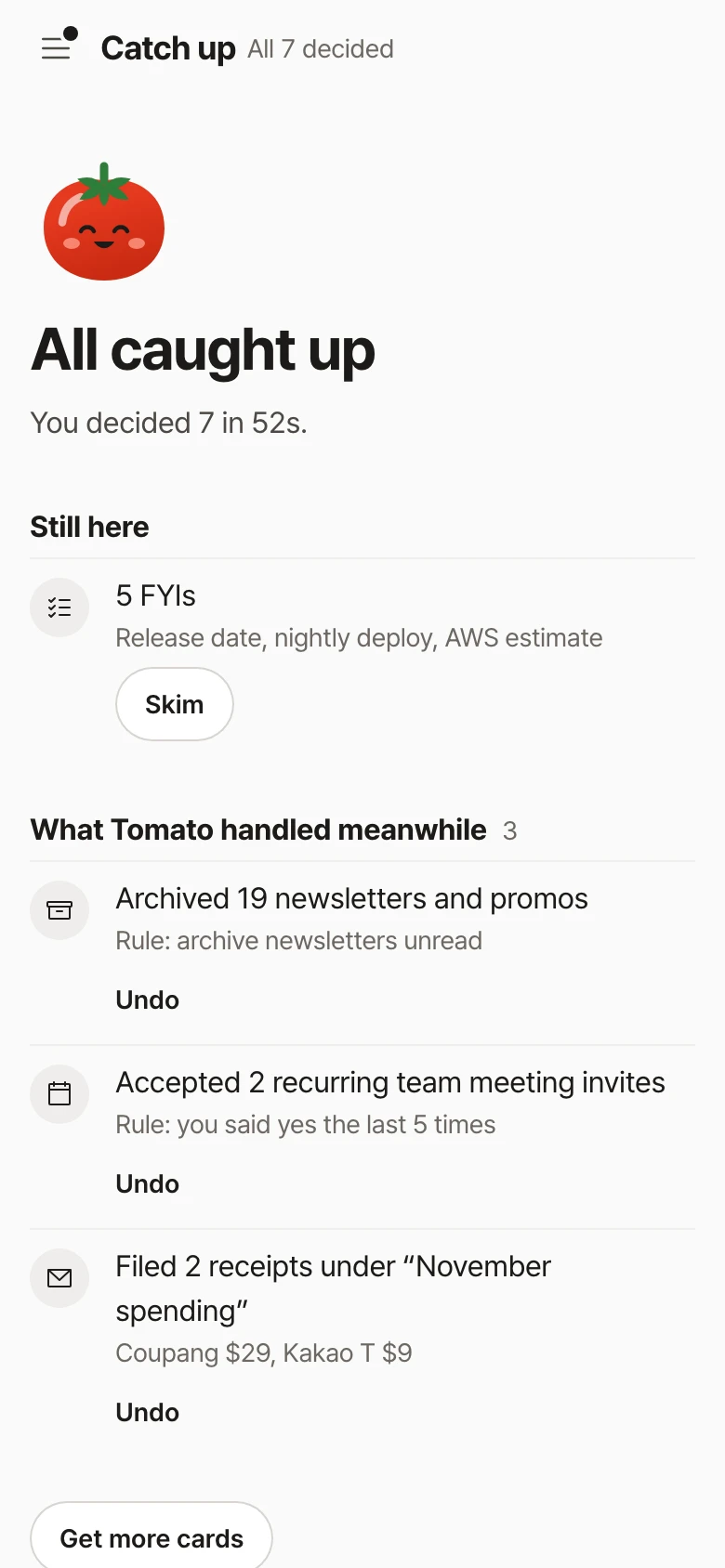
Suggestions come with the facts checked
It looks at everyone’s calendar before it suggests a time.
- New events are marked as new
- Updated invites go out only after you choose
Tomato reads mail, chats and coding agents, and brings back only decisions.
In development. Web first, then iPhone and iPad.
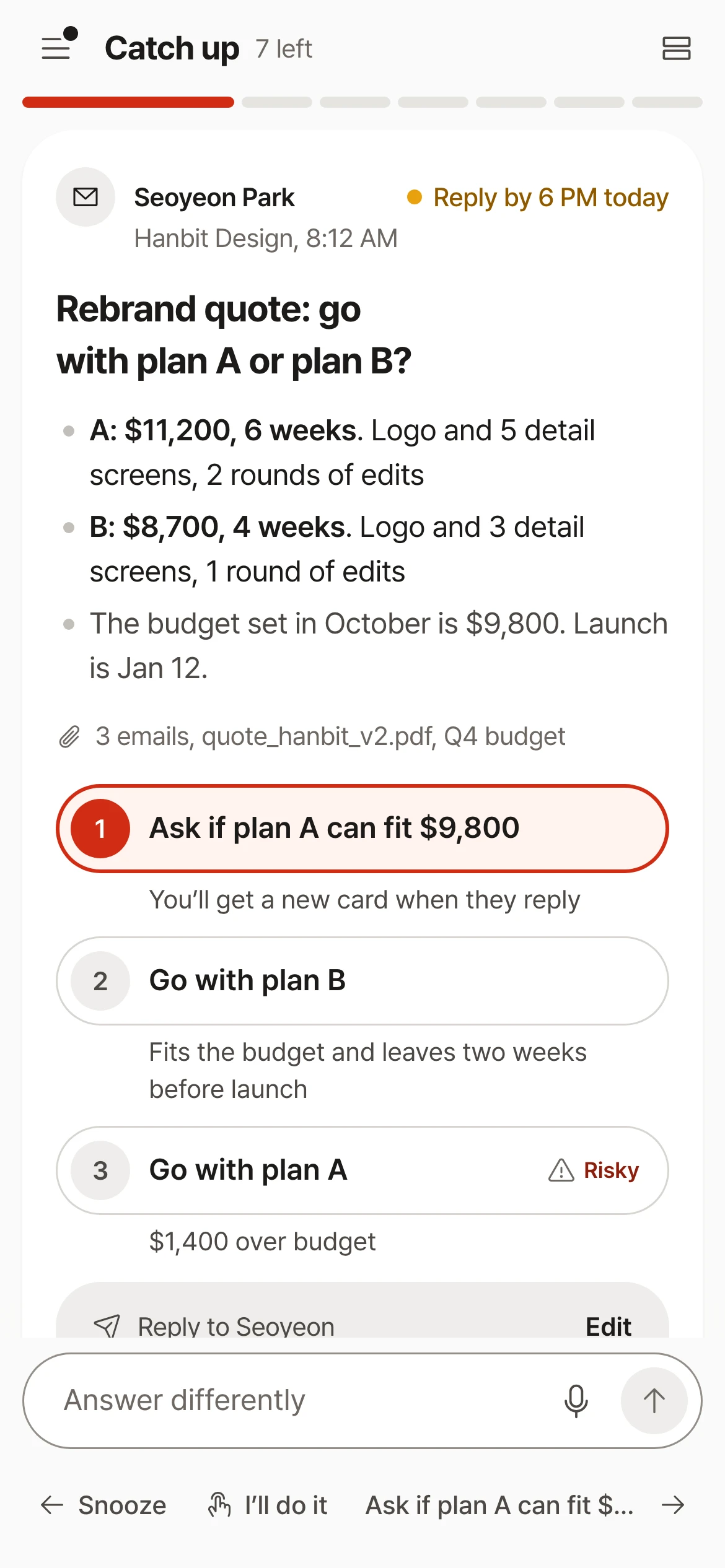
On a phone, it opens in a new tab. Same prototype.
Try the prototypeInstead of opening your inbox, Slack, group chats and calendar one by one, let Tomato read them first and bring back only what’s waiting on you.
140came in overnight41 emails, 63 Slack messages, 5 invites, 5 agent updates …
7need youThe rest was handled, or folded into one FYI digest.
10 secper cardOne question, three lines of context, a few options. No need to open the original.
Everything from the places you connect, grouped by conversation. It runs in the cloud, so it keeps working while your devices are off.
Handled, FYI, or needs you. When in doubt, it asks. A missed decision costs more than an extra card.
Answer with a number, or say what you want instead.
Numbers are from the sample cards.
An email reply, a calendar clash, an agent asking for approval: each one is a question with a few answers.
Try these in the prototypeIt looks at everyone’s calendar before it suggests a time.

Claude Code and Codex run in your own space in the cloud. You only hear from them when they have a question or need approval, and they pick up the moment you answer.

Production data, money and anything irreversible can’t be swiped away or time out. You confirm twice.

Tell it “I have a wedding on Saturday” and it checks your calendar and comes back with new options. You still finish with one number.

Release dates, deploy results, billing estimates. Worth knowing, nothing to decide.

No bare error messages. You get what went wrong, where things stand, and ways to fix it.
You decide what to hand over. Everything it does is logged, and anything reversible can be undone.
After you give the same answer five times, it asks whether to handle it from now on.
Replies, invites and comments wait ten seconds before they go out.
Payments, production data and irreversible actions are rules you can’t turn off.
Text from outside is something to summarize, never an instruction to follow.

The activity log shows what happened, when, and under which rule. Turn auto-handling on or off from the same place.
We only connect through official, permitted APIs, and we say plainly what works and what doesn’t.
| When | Service | What it does |
|---|---|---|
| From day one | Codex | Questions and approvals |
| Claude Code | Questions and approvals | |
| Gmail | Read and reply | |
| Google Calendar | Accept and reschedule | |
| Next | Slack | Mentions and replies |
| KakaoTalk channel | Get cards, paste in chats | |
| GitHub | Review requests | |
| Telegram | Chats and replies | |
| Later | Outlook and Microsoft 365 | Mail and calendar |
| Naver and Daum Mail | Read and reply | |
| Notion, Linear and Jira | Comments and changes | |
| Instagram and X | Business messages |
Only cards someone is waiting on, or that are due today, send a notification. Long-press to answer in place. Risky ones open the app.
Web first, then iPhone and iPad apps.
No. KakaoTalk has no official way to read chats, so we don’t. Add the Tomato KakaoTalk channel to get your cards there, and paste in any conversation you want sorted.
Yes. The assistant runs in your own space in the cloud. Your cards will be waiting when you’re back.
Not at first. It only does what you choose, and anything outgoing waits ten seconds so you can undo it. It offers to take over only after the same answer keeps coming up.
Every person gets a separate space in the cloud, with their data and connections encrypted under their own key.
We’re building it now. The web app comes first, then iPhone and iPad. In English and Korean.
Only the decisions, as cards. Coming soon.